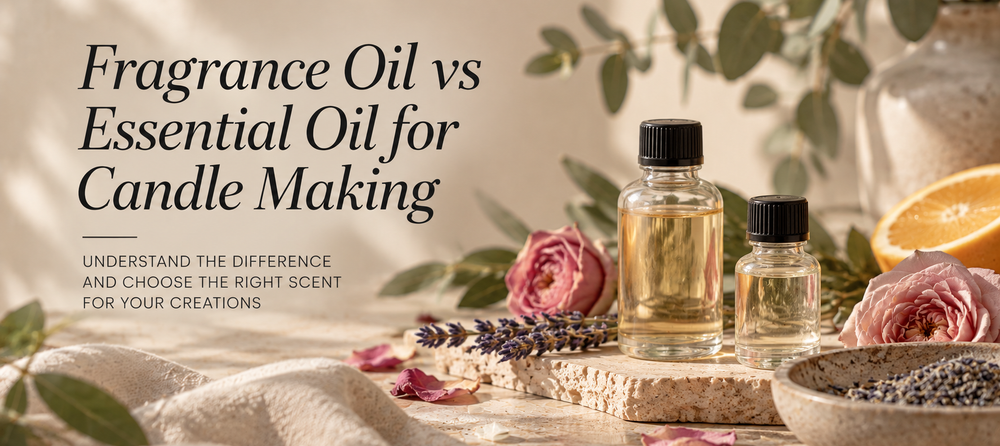
Many new candle makers assume essential oils are the best choice because they’re natural. But when it comes to candle making, the answer isn’t always that simple. Here’s what every candle maker should know before choosing between fragrance oils and essential oils.
Introduction
If you’ve spent any time researching candle making online, you’ve probably come across the same advice over and over again:
“Use essential oils because they’re natural.”
For many beginners, it seems like an obvious choice.
Consumers are increasingly looking for natural products, essential oils sound premium, and social media is full of claims about their benefits. It’s easy to assume that essential oils must automatically be the better option for candle making.
However, the reality is often very different.
At Craft HQ, we’ve worked with candle makers at every stage of their journey, from hobbyists making candles in their kitchens to established brands developing full home fragrance collections. One of the most common disappointments we see is candle makers investing heavily in essential oils, only to discover that their finished candles produce very little scent when burned.
So what’s really the difference between fragrance oils and essential oils?
And which option is best if you’re trying to create candles that customers genuinely love?
Let’s break it down.
What’s the Difference Between Fragrance Oils and Essential Oils?

Although both are used to add scent to candles, they are completely different products.
What Are Essential Oils?
Essential oils are concentrated aromatic compounds extracted directly from plants.
Depending on the oil, they may come from:
- Flowers
- Leaves
- Bark
- Roots
- Fruits
- Seeds
Popular examples include:
- Lavender
- Peppermint
- Lemon
- Eucalyptus
- Tea Tree
Because they originate from natural plant materials, essential oils are often associated with wellness, aromatherapy, and natural living.
What Are Fragrance Oils?
Fragrance oils are specially formulated scent blends designed for products such as candles, reed diffusers, soaps, and home fragrance products.
Unlike essential oils, fragrance oils can recreate scents that don’t naturally exist.
Examples include:
- Fresh Linen
- Baby Powder
- Pumpkin Spice
- Sea Salt & Driftwood
- Black Plum & Rhubarb
- Birthday Cake
Expert Insight from Craft HQ

One thing many new candle makers don’t realise is that some of the most popular candle fragrances in the world simply don’t exist in nature.
There is no Fresh Linen essential oil.
There is no Birthday Cake essential oil.
There is no Black Cherry Merlot essential oil.
These fragrances can only be created through fragrance oil formulation.
Why Most Professional Candle Brands Use Fragrance Oils
This is often where new candle makers are surprised.
Despite the popularity of essential oils, the majority of commercial candle brands use fragrance oils as their primary fragrance source.
Why? Because candle making places unique demands on fragrance performance.
Better Scent Throw
One of the biggest advantages of fragrance oils is their ability to produce strong scent throw.
Candle makers typically evaluate fragrance performance in two ways:
Cold Throw
The fragrance released when the candle is unlit.
Hot Throw
The fragrance released while the candle is burning.
Many fragrance oils are specifically designed to perform well in both areas.
Greater Fragrance Variety
Fragrance oils give brands significantly more creative freedom.
| Essential Oils | Fragrance Oils |
| Lavender | Fresh Linen |
| Lemon | Clean Cotton |
| Peppermint | Pumpkin Spice |
| Eucalyptus | Sea Salt & Driftwood |
| Orange | Black Plum & Rhubabrb |
For candle brands looking to create seasonal collections or unique fragrance experiences, fragrance oils provide far greater flexibility.
Better Consistency
Consistency is essential when building a candle business.
Customers expect a fragrance to smell the same every time they purchase it.
Because essential oils are natural products, their scent profile can vary depending on:
- Harvest conditions
- Weather
- Soil quality
- Growing region
Fragrance oils generally provide much greater consistency from batch to batch.
More Cost Effective
This is one area many new business owners overlook.
Premium essential oils can be significantly more expensive than fragrance oils. When multiplied across hundreds or thousands of candles, the cost difference can become substantial.
The “Natural” Marketing Trap
One mistake we occasionally see from new candle brands is building their entire strategy around the word “natural.”
While natural ingredients can absolutely have a place in home fragrance products, consumers ultimately judge a candle on its performance.
If a candle claims to smell like lavender but produces very little scent when burned, customers rarely care whether the ingredient was natural or synthetic.
They simply feel disappointed.
The challenge for modern candle brands is finding the right balance between:
- Ingredient story
- Fragrance performance
- Customer expectations
- Commercial viability
Expert Insight from Craft HQ
Many successful candle brands use fragrance oils not because they’re cheaper, but because they consistently deliver the scent experience customers expect.
Can You Make Candles with Essential Oils?

Absolutely. Many candle makers successfully use essential oils.
However, there are some important challenges to understand before choosing this route.
Weaker Scent Throw
Perhaps the most common issue is weak hot throw.
Many essential oils simply don’t perform as strongly in candles as fragrance oils.
Heat Sensitivity
Some essential oils can be sensitive to the temperatures involved in candle making.
This can affect how the fragrance performs once the candle is burned.
Higher Production Costs
Essential oils often require a larger investment, particularly when producing candles at scale.
More Testing
Achieving strong performance with essential oils frequently requires additional testing and formulation work.

What Happens When You Actually Test Both?
Let’s imagine two candles.
Both use:
- The same wax
- The same wick
- The same vessel
- The same cure time
The only difference is the fragrance source.
Candle A
Uses a professionally formulated candle fragrance oil.
Candle B
Uses a premium essential oil.
Before lighting them, both candles may smell fantastic.
However, once burned, the results can be very different.
In many cases, Candle A will fill the room much more effectively.
This is one of the reasons fragrance oils remain the preferred option for most commercial candle brands.
Which Option Is Best for Starting a Candle Business?
If someone came to us tomorrow looking to launch their first candle brand, our recommendation would usually be fragrance oils.
Not because essential oils are bad.
But because fragrance oils generally provide:
- Stronger scent throw
- Greater consistency
- Easier testing
- Lower production costs
- More fragrance variety
Once a brand understands the fundamentals of candle making, it can then explore more specialised formulations involving essential oils if that aligns with its positioning.
5 Common Myths About Essential Oils in Candles

Myth #1: Natural Always Means Better
Not necessarily. Performance matters just as much as ingredient origin.
Myth #2: Essential Oils Always Smell Stronger
In candles, this is often not the case.
Myth #3: Customers Only Want Natural Candles
Most customers want candles that smell great and perform well.
Myth #4: All Fragrance Oils Are Synthetic
Many fragrance oils contain naturally derived components alongside formulated ingredients.
Myth #5: Essential Oils Are Easier to Work With
In reality, they often require more testing and troubleshooting.
Final Thoughts
The debate between fragrance oils and essential oils isn’t really about which one is universally better. It’s about choosing the right tool for the job.
For most candle makers and growing candle brands, fragrance oils offer the strongest combination of performance, consistency, creativity, and commercial viability.
Essential oils can absolutely have a place within candle making, particularly for brands focused on natural positioning or aromatherapy-inspired products.
The key is understanding the strengths and limitations of each option before investing time and money into product development.
The most successful candle makers aren’t the ones who follow trends. They’re the ones who test, learn, and choose ingredients based on performance rather than assumptions.
Frequently Asked Questions Can I mix fragrance oils and essential oils?
Yes, some candle makers use blends of both, although compatibility testing is essential.
Which lasts longer in candles?
Fragrance oils typically provide longer-lasting and more consistent scent throw.
Why can’t I smell my essential oil candle?
The issue may be related to wick selection, wax type, fragrance load, or the essential oil itself.
Are fragrance oils safe for candle making?
When sourced from reputable suppliers and used according to recommended guidelines, fragrance oils are widely used throughout the candle industry.
Sources
- National Candle Association
- British Candlemakers Federation
- International Fragrance Association (IFRA)
Comments